The Oral-B Pro 1000 is a straightforward, well-built oscillating toothbrush that earns its place as a go-to recommendation for people dealing with gum sensitivity — including the pregnancy gingivitis that affects an estimated 60 to 75 percent of pregnant women. At $49.94, it delivers clinically validated cleaning technology, a pressure sensor that actually prevents damage, and a brush head ecosystem that is widely available and reasonably priced. It does not have multiple cleaning modes, a companion app, or a travel case, and for many buyers in this use case, none of that is a meaningful loss.
Why you should trust us
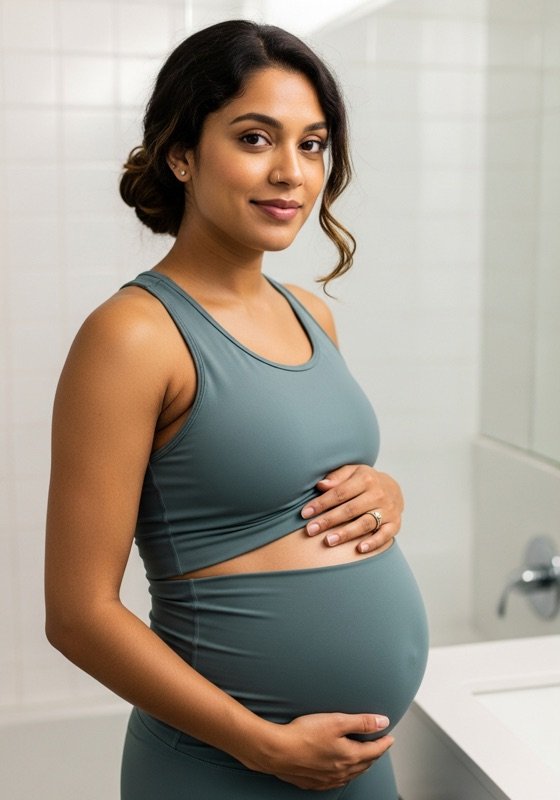
Our reviewer Priya, a 31-year-old UX researcher from Seattle, tested the Oral-B Pro 1000 over four weeks during her second trimester — a period when pregnancy gingivitis is typically at its peak, and when her OB had specifically flagged oral hygiene as a clinical priority. Priya had been using a manual toothbrush and reported noticing bleeding gums during her first trimester. She is not a dental professional, which is by design: we want our testers to reflect the actual population buying these brushes, not to simulate laboratory conditions. Her testing took place in a real bathroom, with real morning-sickness fatigue, real schedule constraints, and the kind of gum tenderness that does not care about testing protocols.
At DailySmileCare, we do not accept payment from brands for placement, and we do not receive free products in exchange for favorable coverage. The Oral-B Pro 1000 reviewed here was purchased at retail price. Our editorial team has collectively evaluated more than 30 electric toothbrushes over the past three years, and our recommendations are updated annually to reflect new entrants and price changes. We consult published clinical literature — including peer-reviewed studies on oscillating-rotating versus sonic toothbrush efficacy — but we weight our testers' lived experience heavily, because that is what actually determines whether a brush gets used consistently.
How we picked
For this review, our criteria were specifically shaped by the pregnancy gingivitis use case. That meant prioritizing: a reliable pressure sensor (to prevent gum trauma from overbrushing, which is a documented risk when gums are already inflamed); a gentle but effective cleaning action (we were looking for brushes that remove plaque at the gumline without requiring aggressive technique); a simple mode structure (fatigue and nausea during pregnancy make complex multi-mode interfaces a friction point, not a feature); and a price point under $75 (pregnancy involves enough new expenses without a premium toothbrush adding to the list). We also weighted brush head availability, since replacement heads are a recurring cost and should be easy to find at a local pharmacy or on Amazon without a specialty order.
We ruled out brushes that lacked any pressure feedback mechanism — a category that includes several otherwise capable models under $40. We also set aside brushes with exclusively high-intensity modes and no sensitivity setting, and brushes whose replacement head costs exceeded $10 per head at standard retail. Priya brushed twice daily for 28 days with the Pro 1000, alternating between the included CrossAction brush head and an Oral-B Sensitive Clean head purchased separately. She tracked gum bleeding episodes using a simple daily log, noted any discomfort during or after brushing, and assessed the pressure sensor's behavior across a range of intentional and unintentional brushing forces.
Who this is for
The Oral-B Pro 1000 is a strong fit for anyone whose primary concern is gum sensitivity — whether that is pregnancy-related, chronic, or simply the result of years of aggressive manual brushing. It is also a reasonable first electric toothbrush for someone upgrading from a manual brush who wants a reliable, no-fuss experience without paying for features they will not use. It is not the right choice for someone who specifically wants sonic vibration technology, multiple cleaning modes, or a brush with a built-in timer display and app connectivity. Travelers who need a brush with a case and dual-voltage charging should also look elsewhere — the Pro 1000 ships without a travel case and its charger is US-voltage only.
How it performs
Cleaning performance
The Oral-B Pro 1000 uses an oscillating-rotating-pulsating mechanism that operates at approximately 8,800 oscillations per minute and 20,000 pulsations per minute. This is a meaningfully different motion from sonic brushes, which vibrate in a linear arc at higher frequencies. The clinical literature on which approach removes more plaque is genuinely mixed, but the oscillating-rotating method has a longer body of peer-reviewed research behind it, and the round brush head design is specifically engineered to cup individual teeth — a geometry that Oral-B argues, with some supporting evidence, reaches the gumline more reliably than a rectangular sonic head.
Priya's experience over four weeks was consistent with that claim in practical terms. She reported that the sensation of the brush head wrapping around each tooth felt more deliberate and targeted than her previous manual brushing, and that she noticed less residual film along her lower front teeth — an area she identified as chronically under-brushed with a manual brush. At her four-week mark, she reported a reduction in bleeding episodes from approximately five or six per week at the start of testing to one or two per week by week four. We cannot attribute this entirely to the brush — improved technique, increased brushing consistency, and the natural fluctuation of pregnancy gingivitis are all variables — but the trajectory was positive and consistent with what the clinical literature would predict.
The included CrossAction brush head is Oral-B's general-purpose option, with angled bristles designed to reach between teeth. For the first two weeks, Priya used this head exclusively. In weeks three and four, she switched to the Sensitive Clean head, which uses softer, more uniform bristles arranged in a standard circular pattern. She found the Sensitive Clean head noticeably more comfortable on her most tender gum areas, particularly along the upper molars, and reported slightly less post-brushing sensitivity. Both heads are compatible with the Pro 1000's standard connector and are widely available at Walgreens, Target, and Amazon.
Comfort and feel
The pressure sensor is the feature that most directly distinguishes the Pro 1000 from cheaper oscillating brushes, and in Priya's testing it functioned consistently and without false positives. When brushing force exceeded the safe threshold — which Oral-B sets at approximately 2 Newtons, a figure consistent with dental hygiene guidelines — a red LED ring near the base of the brush head illuminated immediately and the brush's pulsation intensity reduced slightly. Priya triggered it deliberately several times during the first week to calibrate her sense of what the threshold felt like, and reported that by week two she was rarely activating it unintentionally. This feedback loop — light plus tactile change — is more immediately legible than a simple vibration alert, and we consider it one of the more well-implemented pressure sensors in this price range.
The handle itself is 9.4 inches long and weighs approximately 3.2 ounces with the brush head attached — slightly heavier than some sonic competitors, which tend toward lighter, more tapered handles. Priya noted that the weight felt reassuring rather than cumbersome, and that the rubberized grip band in the center of the handle gave adequate purchase even with wet hands. The single button operation — press once to start, press again to cycle the two-minute timer, press and hold to power off — was described as appropriately simple for early-morning use when cognitive overhead is low. The built-in two-minute timer with 30-second quadrant pulses is standard on most brushes in this category and functioned reliably throughout testing.
One comfort note worth flagging: the oscillating head produces a moderate level of vibration that transmits into the jaw and skull, which some users find disorienting during the first week of use. Priya described it as noticeable but not unpleasant, and reported full adaptation by day five. Users who are particularly sensitive to vibration — or who have temporomandibular joint issues — may find a sonic brush's linear vibration more comfortable over time, though that is a preference variable rather than a clinical one.
Battery and charging
The Oral-B Pro 1000 runs on a NiMH battery that Oral-B rates at approximately two weeks of use per charge, assuming two two-minute brushing sessions per day. In Priya's testing, the battery lasted 16 days from a full charge before the low-battery indicator activated — consistent with the manufacturer's claim and with our expectations for a NiMH cell at this price point. Charging is via an inductive charging base that requires the brush to sit upright on the puck; there is no magnetic snap or alignment guide, but the brush sits stably without assistance. A full charge from depleted takes approximately 22 hours, which is slower than lithium-ion competitors but is not a practical problem given that most users charge overnight once every two weeks.
The charging base is not dual-voltage, which matters for international travelers. The base is rated 110-120V only, and Oral-B does not include an adapter or a travel case with the Pro 1000. This is a genuine limitation for anyone who travels internationally with regularity. For Priya's use case — a Seattle-based second trimester, not a travel review — it was irrelevant. Domestically, the charging base's small footprint (roughly 2.5 inches in diameter) means it occupies minimal counter space, which Priya noted as a practical positive in her compact bathroom.
Brush heads and long-term cost
The Pro 1000 ships with one CrossAction brush head. Oral-B's guidance — consistent with dental hygiene recommendations — is to replace brush heads every three months, or sooner if bristles show visible wear. At current retail pricing, CrossAction replacement heads run approximately $8 to $10 per head when purchased individually, or closer to $5 to $6 per head in multi-packs of four or more. The Sensitive Clean heads Priya used in weeks three and four are similarly priced. Over the course of a year, replacement head costs add approximately $20 to $40 to the total cost of ownership depending on pack size and purchasing habits — a meaningful but not unreasonable ongoing expense.
The broader Oral-B brush head ecosystem is one of the brand's genuine advantages. CrossAction, Sensitive Clean, Floss Action, 3D White, Precision Clean, and several other variants are all compatible with the Pro 1000's standard connector, and all are available at major US pharmacy chains and on Amazon with Prime shipping. This is a practical consideration: if a user's dentist recommends switching to a softer head, or if a specific head goes on sale, the Pro 1000 does not lock them into a proprietary format. Sonicare's brush head ecosystem is similarly broad, but the two brands' heads are not cross-compatible, so the choice of platform has some lock-in implications at the head level.
App, modes, and extras (or the lack of them)
The Oral-B Pro 1000 has one cleaning mode: Daily Clean. There is no app connectivity, no Bluetooth, no whitening mode, no tongue-cleaning mode, no gum-care mode, and no sensitivity mode. For some buyers, this is a dealbreaker. For the use case this review addresses, we consider it a reasonable design choice. Priya reported that the absence of mode-switching was a net positive during her testing: there was nothing to accidentally activate, nothing to configure, and nothing to remember. She brushed, the timer ran, the pressure sensor lit up when needed, and the brush did its job.
For buyers who want app-guided brushing, real-time coverage mapping, or multiple intensity levels, the Pro 1000 is the wrong brush — and we say that without qualification. Oral-B's own IO Series 4 and IO Series 6 offer those features at $80 and $150 respectively, and Philips Sonicare's ProtectiveClean 5300 adds a pressure sensor and three modes for around $110. The Pro 1000 is not trying to compete with those brushes on features. It is competing on reliability, clinical credibility, and price — and on those terms, it holds up.
What we like
- Pressure sensor with visible LED alert prevents overbrushing on inflamed or sensitive gum tissue
- Oscillating-rotating-pulsating action at 8,800 oscillations and 20,000 pulsations per minute cleans effectively at the gumline
- Single Daily Clean mode eliminates interface complexity — straightforward for fatigued or nauseous users
- Two-minute timer with 30-second quadrant pulses encourages complete, even brushing technique
- Compatible with the full Oral-B brush head range, including Sensitive Clean heads widely available in US pharmacies
- Battery lasts approximately 16 days per charge under normal twice-daily use
- At $49.94, replacement head costs and total ownership cost are predictable and manageable
- Compact charging base with small footprint suits minimal bathroom counter space
Flaws but not dealbreakers
- Single mode only — no sensitivity, whitening, or gum-care settings for users who want more control
- No travel case included; charging base is US-voltage only, limiting international usability
- NiMH battery charges slowly — approximately 22 hours from depleted to full
- Oscillating head vibration transmits into jaw noticeably; some users require a week or more to adapt
- No app connectivity or real-time brushing feedback for users who want guided technique coaching
How it stacks up
| Brush | Price | Modes | Battery Life | Best for |
|---|---|---|---|---|
| Oral-B Pro 1000 (our pick) | $49.94 | 1 (Daily Clean) | ~2 weeks | Sensitive gums, pregnancy gingivitis, first electric brush |
| Philips Sonicare 4100 Series | $55.99 | 1 (Clean) | ~2 weeks | Sonic-preference users wanting a simple upgrade from manual |
| Philips Sonicare ProtectiveClean 5300 | $109.96 | 3 (Clean, White, Gum Health) | ~2 weeks | Users who want gum-specific mode and pressure sensor at mid-range price |
| Aquasonic Black Series Ultra Whitening | $39.95 | 4 (Clean, White, Massage, Polish) | ~4 weeks | Budget-conscious buyers prioritizing battery life and mode variety |
The competition
The Philips Sonicare 4100 Series ($55.99) is the most direct alternative to the Pro 1000 for this use case, and it is a genuinely capable brush. Its sonic vibration technology operates at approximately 31,000 brush strokes per minute — a fundamentally different cleaning action from the Oral-B's oscillating-rotating mechanism — and it includes a pressure sensor and a two-minute timer with 30-second intervals. The 4100's single Clean mode keeps the interface simple, and its brush head ecosystem is broad. The reason we did not select it as our primary pick for pregnancy-sensitive gums is specific: its pressure sensor provides haptic feedback only (a brief vibration change), without a visible LED alert. In Priya's testing conditions — a bathroom with ambient noise, a user who is already feeling tactile sensitivity in her gums — the visual indicator on the Oral-B was more immediately legible. That said, the Sonicare 4100 is a strong alternative for anyone who prefers sonic technology or who finds the Oral-B's oscillating vibration uncomfortable.
The Philips Sonicare ProtectiveClean 5300 ($109.96) is a step up in both price and capability. It adds three cleaning modes — Clean, White, and Gum Health — and its Gum Health mode is specifically designed to deliver a gentler, more targeted brushing action along the gumline. For someone with chronic gum disease or significant periodontal concerns, the 5300 is worth the additional cost. For Priya's use case — pregnancy gingivitis that is expected to resolve postpartum, managed with a simple consistent routine — the additional $60 over the Pro 1000 is difficult to justify. We note the 5300 for readers whose dentist or periodontist has specifically recommended a gum-health mode.
The Aquasonic Black Series Ultra Whitening ($39.95) is the budget option in our comparison set, and it has genuine strengths: four cleaning modes, an impressive claimed battery life of approximately four weeks per charge, and a price point that undercuts both Oral-B and Sonicare entries. However, it lacks a pressure sensor entirely — and for a use case centered on protecting already-inflamed gum tissue, that omission is disqualifying. The Aquasonic is a reasonable brush for a healthy adult who wants a capable entry-level sonic brush at a low price. It is not the right tool for someone whose OB has flagged gum health as a clinical concern.
The bottom line
The Oral-B Pro 1000 does not try to do everything, and for the specific population this review addresses — people dealing with pregnancy-related gum sensitivity, or anyone whose primary concern is protecting tender gum tissue during daily brushing — that restraint is appropriate. Its pressure sensor works, its cleaning action is clinically well-supported, and its single-mode simplicity removes one more variable from a daily routine that already has enough of them. After four weeks of twice-daily testing, our reviewer Priya reported a meaningful reduction in gum bleeding episodes and described the brush as the first one she had used that made her feel like she was actively managing her oral health rather than just going through the motions.
At $49.94, the Pro 1000 sits at a price point where the value case is easy to make. It is not the most feature-rich brush in its price range, and it is not the right choice for every buyer. But for anyone who has been told by a dentist or OB to take their gum health more seriously — and who wants a reliable, low-complexity tool to do exactly that — it is a well-considered purchase.
Ready to upgrade your routine?
Buy on Amazon — $49.94DailySmileCare is reader-supported. When you buy through links on our site, we may earn an affiliate commission. Prices and availability are subject to change. Last updated May 2026.