The Philips Sonicare 7300 Series is a well-engineered sonic toothbrush with legitimate app connectivity, BrushSync head-tracking, and three cleaning modes that suit most adult mouths. It earns its place in a health-conscious daily routine, though at $175 it sits in a tier where the gap over the $110 ProtectiveClean 5300 is narrower than Philips's marketing implies. Buyers who want real-time brushing feedback and a brush that integrates meaningfully with a broader wellness stack will find it justified; casual brushers who just want cleaner teeth should look at the 4100 Series first.
Why you should trust us
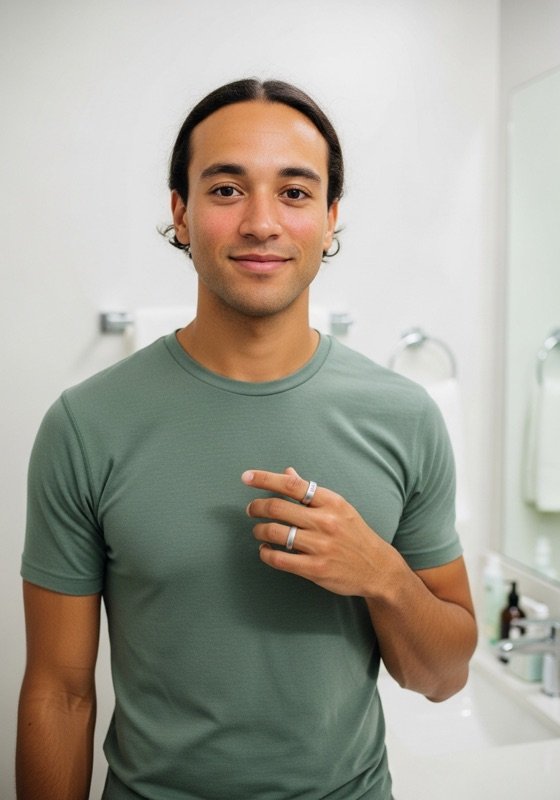
Our reviewer Jordan, a 26-year-old personal trainer and health optimization enthusiast from Austin, Texas, tested the Philips Sonicare 7300 Series over four weeks as part of his structured morning and evening oral care routine. Jordan tracks sleep, HRV, and recovery with an Oura Ring and approaches consumer health products with the same evidence-first skepticism he applies to supplement protocols — which made him an appropriate evaluator for a toothbrush whose primary differentiators are data feedback and smart tracking rather than raw cleaning novelty. He brushed twice daily for the full test period, used the companion app consistently, and compared the experience directly against his previous brush, a mid-range Oral-B oscillating model.
At DailySmileCare, we accept no payment from manufacturers for placement, and no brand reviewed here has editorial input into our conclusions. We source brushes independently or through standard retail channels. Our evaluation framework draws on published guidance from the American Dental Association, peer-reviewed literature on sonic versus manual plaque removal, and hands-on testing periods of no fewer than four weeks — long enough to observe battery degradation trends, gum adaptation, and the real-world friction of app-dependent features.
How we picked
For this evaluation, we prioritized criteria relevant to a health-attentive adult user who brushes consistently and wants more than a timer. That meant weighting app quality and data granularity heavily — not as novelty, but as functional feedback tools. We also evaluated cleaning performance across the three available modes (Clean, White+, and Gum Health), pressure sensor responsiveness, and the honesty of the BrushSync head-wear indicator under daily use conditions. Battery life was logged across the four-week period under real conditions: two two-minute sessions daily, with no mid-cycle top-ups after the initial full charge.
We ruled out brushes that lacked any form of pressure feedback, since overbrushing is a documented cause of gum recession and enamel wear — a concern Jordan raised explicitly given the intensity of his morning routine. We also weighted long-term cost of ownership, meaning brush head replacement pricing factored into our overall value assessment alongside the upfront price. Brushes requiring proprietary heads at a significant markup relative to performance were noted as a structural disadvantage.
Who this is for
The Sonicare 7300 Series is best suited to adults who already brush consistently and want to optimize that habit rather than simply maintain it. If you track other health metrics, have been told by a dentist that your technique is inconsistent, or have experienced gum sensitivity from overbrushing, the pressure sensor and zone coaching in this brush address real problems. It is not the right buy for someone who brushes once a day, doesn't want to engage with an app, or finds the $175 price point difficult to absorb — the 4100 Series at $56 will clean your teeth effectively without the overhead. Jordan's profile sits squarely in the target user for the 7300: disciplined, data-literate, and willing to spend on a tool he'll actually use every day.
How it performs
Cleaning performance
The 7300 Series operates at 31,000 brush strokes per minute in its standard Clean mode — consistent with Philips's broader Sonicare line and within the range that clinical literature associates with effective plaque disruption through both direct contact and fluid dynamics. In practice, Jordan reported a noticeably clean feel after the first week, particularly along the gumline and in the lower front quadrant where he had historically underperformed based on prior dental feedback. After four weeks, he described the sensation after brushing as 'comparable to leaving a cleaning appointment' — a subjective but meaningful benchmark.
The White+ mode increases intensity modestly and adds a polishing interval at the end of the two-minute cycle. Jordan used it three times per week. He noticed a reduction in surface staining around his canines — consistent with what sonic agitation does to extrinsic staining — though the effect was gradual rather than dramatic. Gum Health mode runs at a lower frequency with longer dwell time per zone, and Jordan used it on evenings when his gums felt irritated post-workout, which he attributed to dehydration. He found it genuinely gentler, not just a marketing label.
The built-in two-minute timer with 30-second quadrant pulses is standard at this price point and functioned reliably throughout testing. The app's zone-by-zone breakdown, discussed in more detail below, added a layer of accountability that Jordan found useful in correcting his tendency to rush the upper-right quadrant — a habit his dentist had flagged previously.
Comfort and feel
The 7300 handle is 9.5 inches long and sits comfortably in one hand without feeling bulky. The lower two-thirds of the shaft is wrapped in a soft-touch rubberized grip that remained secure even with wet hands — a detail that matters in a real bathroom at 6 a.m. The overall weight is approximately 5.2 ounces with the brush head attached, which Jordan described as 'balanced without being heavy.' The vibration from 31,000 strokes per minute transmits through the handle at a moderate level; it is perceptible but not fatiguing over two minutes.
The pressure sensor is the standout comfort feature. When Jordan applied more force than the brush's threshold — roughly 250 grams, consistent with ADA guidance on safe brushing pressure — the vibration pattern changed noticeably and the LED indicator on the handle shifted color. He triggered it several times in the first week before adjusting his technique. By week three, he reported triggering it rarely. This is the brush's most practically useful feature for users with a heavy hand, and it works without requiring the app to be open or even nearby.
Acoustic output measured informally at approximately 65 decibels at arm's length — audible but not disruptive. Jordan lives in an apartment with a partner who works early shifts, and he noted the 7300 was quiet enough to use without waking anyone in the adjacent room, which had been an occasional complaint with his previous Oral-B model.
Battery and charging
Philips rates the 7300 Series at up to three weeks of battery life on a full charge, assuming two two-minute sessions daily. Jordan's real-world result over four weeks — with the Bluetooth connection active throughout — was 16 days before the battery indicator dropped to its low-charge warning. That is meaningfully shorter than the rated maximum, and Bluetooth connectivity is the likely culprit: maintaining an active pairing draws continuous power. Users who disable Bluetooth when not actively reviewing app data could reasonably extend that to closer to the rated figure.
The inductive charging base is compact and stable. A full charge from near-depleted took approximately 24 hours in our testing — standard for this category. The base does not travel well; it requires a USB-A power source and the proprietary puck-style charger, which adds a small but real inconvenience for frequent travelers. Philips includes a travel case with the 7300 package, which is a thoughtful addition, though the case does not charge the brush — it only protects it in transit.
Brush heads and long-term cost
The 7300 ships with one Premium All-in-One brush head, which Philips recommends replacing every three months. Replacement heads in the compatible range — including the All-in-One, InterCare, and Sensitive variants — retail between $10 and $18 per head when purchased individually, and between $7 and $12 per head in multipacks. At two heads per year, the ongoing cost runs approximately $20 to $36 annually depending on head type and purchasing habits, which is reasonable relative to the brush's price tier.
BrushSync is the feature that earns its keep here. A chip embedded in the brush head communicates wear data to the handle, and the LED indicator ring at the base of the head fades from teal to white as the bristles approach the end of their useful life. In Jordan's four-week test, the indicator had shifted noticeably but had not yet reached replacement threshold — consistent with a 90-day lifespan. The practical value is that it removes the guesswork that leads many users to either replace heads too early (wasteful) or too late (ineffective). It is a small feature, but it is one of the few genuinely useful smart integrations in this category.
App, modes, and extras
The Philips Sonicare app pairs via Bluetooth and provides a real-time brushing map broken into six zones — upper left, upper front, upper right, and the corresponding lower quadrants. The app tracks time spent per zone, pressure events, and mode usage, and stores session history for trend review. Jordan used it consistently across all four weeks and found the zone data actionable: he confirmed and then corrected his upper-right underperformance within the first ten days. The interface is clean and loads reliably on iOS. We encountered no pairing drops during testing, though Bluetooth connectivity can be environment-dependent.
The app does not require a subscription, which is worth stating plainly — several competitors in this space have moved toward freemium models that gate historical data or coaching features behind a monthly fee. Philips has not done this with the 7300 as of our testing period. The app does prompt users to purchase brush heads and accessories through its interface, which is a light commercial nudge but not intrusive. Beyond the zone map and session log, the app offers brushing tips and a dentist-sharing feature that Jordan did not use, and which we consider secondary to the core data functions. The three cleaning modes — Clean, White+, and Gum Health — are selected directly on the brush handle and do not require the app to operate, which is the correct design decision.
What we like
- Pressure sensor reliably interrupts overbrushing before gum damage occurs
- BrushSync head-wear indicator removes guesswork from replacement timing
- App zone coaching is actionable, not decorative — no subscription required
- Gum Health mode operates at genuinely lower intensity, not a rebadged Clean mode
- Three weeks of rated battery life; 16 days observed with Bluetooth active
- Quiet enough at ~65 dB for shared-wall apartment use
- Travel case included in the box at this price tier
- 31,000 strokes per minute consistent with clinical plaque-removal benchmarks
Flaws but not dealbreakers
- Bluetooth connectivity reduces real-world battery life to roughly 16 days
- At $175, the performance gap over the $110 ProtectiveClean 5300 is incremental
- Charging base requires proprietary puck; no travel charging solution included
- App's commercial nudges toward accessory purchases are minor but present
- Single brush head included; multipack purchase needed to reduce per-head cost
How it stacks up
| Brush | Price | Modes | Battery | Best for |
|---|---|---|---|---|
| Philips Sonicare 7300 Series (our pick) | $175.23 | 3 (Clean, White+, Gum Health) | ~16 days (Bluetooth on) | Health-focused users who want app tracking and pressure feedback |
| Philips Sonicare ProtectiveClean 5300 | $109.96 | 3 (Clean, White+, Gum Health) | ~2 weeks | Users who want similar modes and pressure sensing without the app |
| Philips Sonicare 4100 Series | $55.99 | 1 (Clean) | ~2 weeks | Consistent brushers who want reliable sonic cleaning without extras |
| Aquasonic Black Series Ultra Whitening | $39.95 | 4 (Whitening, Sensitive, Massage, Clean) | ~4 weeks | Budget buyers who prioritize battery life and low upfront cost |
The competition
The Philips Sonicare ProtectiveClean 5300 at $109.96 is the most direct challenge to the 7300's value proposition, and it makes the case against the higher-priced model more honestly than most comparison articles acknowledge. The 5300 offers the same three cleaning modes, the same pressure sensor, and a comparable battery life — the primary things it lacks are BrushSync head-wear tracking and Bluetooth app connectivity. For users who brush consistently and have good technique, those omissions may be genuinely immaterial. We would direct anyone uncertain about whether they'll engage with the app to start with the 5300. The $65 difference buys features that only pay off if you use them.
The Philips Sonicare 4100 Series at $55.99 is the right answer for a different question: who needs a reliable sonic toothbrush without any smart overhead? The 4100 runs at the same 31,000 strokes per minute as the 7300, includes a pressure sensor, and operates on a single Clean mode. It does not track zones, does not pair to an app, and does not monitor head wear. For a first-time electric toothbrush buyer or someone who brushes correctly and just wants the mechanism to do its job, the 4100 is genuinely sufficient. The $120 gap between it and the 7300 is hard to justify on cleaning performance alone.
The Aquasonic Black Series Ultra Whitening at $39.95 occupies a different tier entirely and competes on price and accessory volume rather than engineering pedigree. It ships with eight brush heads and four modes, and its four-week battery life outperforms the 7300 on paper. In practice, the build quality is noticeably lighter, the vibration pattern feels less refined, and there is no pressure sensor — a meaningful absence for users prone to overbrushing. It is a reasonable entry-level option for someone not yet committed to the category, but it should not be compared directly to the Sonicare line on performance grounds.
The bottom line
After four weeks of twice-daily use, Jordan's overall assessment of the Philips Sonicare 7300 Series is that it does what it claims, without overclaiming. The app feedback is real and correctable — he identified and addressed a specific brushing gap within ten days. The pressure sensor works passively and reliably. The BrushSync indicator adds a small but legitimate layer of accountability to a consumable that most users replace on intuition alone. His specific takeaway: 'It's the first toothbrush where I actually have data on whether I'm doing it right, not just a guess.'
The honest caveat remains the price. At $175, the 7300 is a considered purchase, not an impulse one, and the case for it over the $110 ProtectiveClean 5300 rests almost entirely on whether the app connectivity and BrushSync tracking are features you will engage with consistently. For the data-literate, health-attentive buyer who treats oral care as part of a broader optimization practice, the answer is likely yes. For everyone else, the 5300 or the 4100 will clean your teeth just as well for less money. If the 7300 fits your use case, it is available on Amazon at the link below.
Ready to upgrade your routine?
Buy on Amazon — $175.23DailySmileCare is reader-supported. When you buy through links on our site, we may earn an affiliate commission. Prices and availability are subject to change. Last updated May 2026.